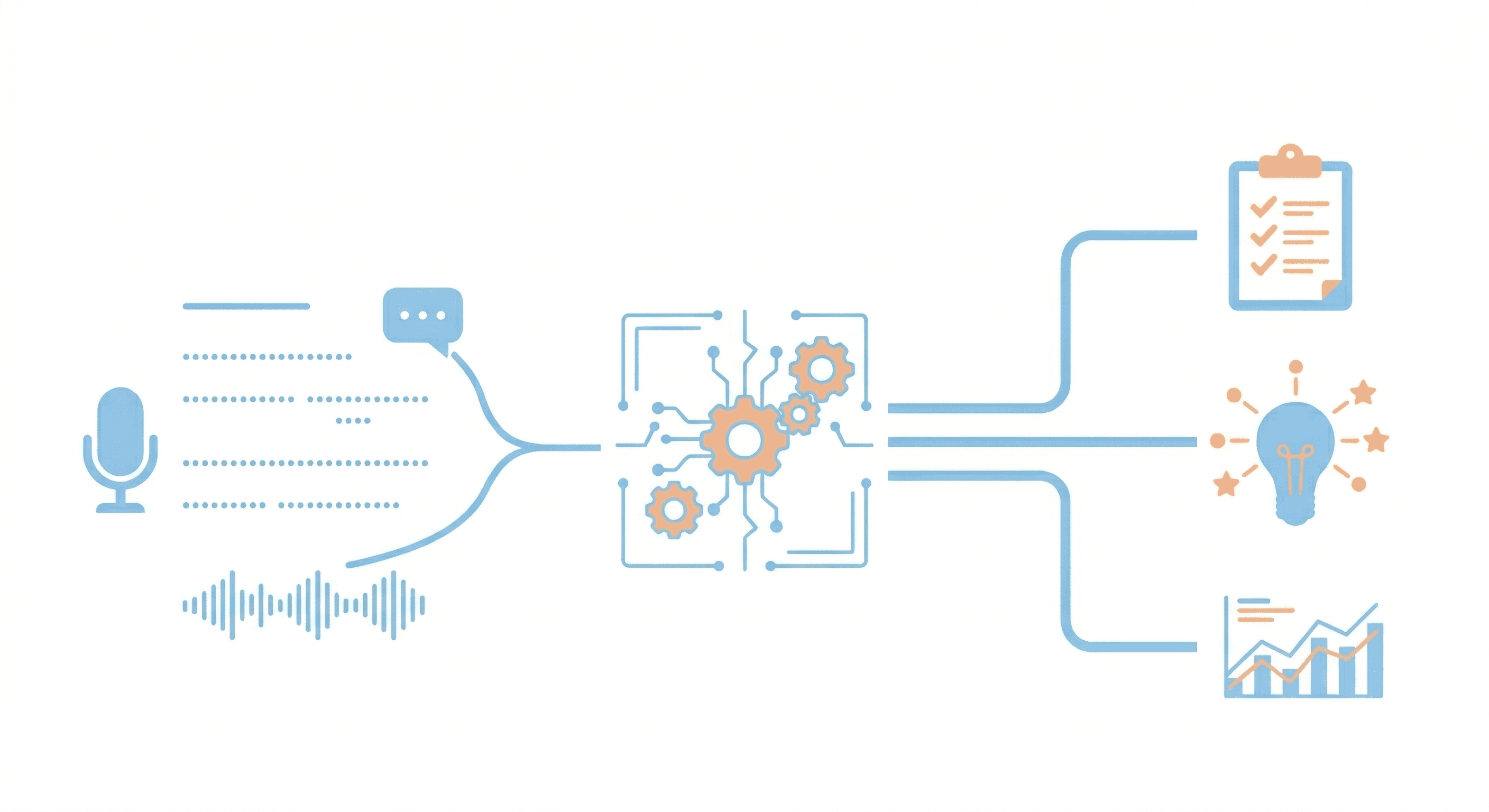
In most client meetings, two layers unfold at the same time. On the surface, participants make decisions, ask questions, and assign action items. Beneath that, clients reference past conversations, rely on unspoken assumptions about their risk tolerance, and mention obligations without fully spelling out the details.
AI notetakers have largely solved the first problem. They capture what was said accurately and quickly, often at near-zero cost. But these tools do not solve the second problem.
Most produce transcripts and summaries. They do not know what those words refer to inside the firm. A client name appears as text. A spouse is just a name. An account is a number with no context. The meaning, which comes from how these references connect to CRM records, financial plans, portfolio data, and prior conversations, is left for someone to reconstruct.
This is not primarily a technical gap. It is structural. Context does not live in the meeting itself. It sits across multiple technology tools that the average advisory firm operates: CRM, portfolio management, financial planning, custodial platforms, and in the experience of advisors who understand how things fit together. A tool that operates outside that layer can record the conversation but cannot interpret it.
In many industries, that limitation is manageable. Someone reviews the notes and fills in the gaps.
In financial advisory, it usually is not. Client conversations are dense with context. A passing comment about a child's college timeline, a question about long-term care, or a mention of a recent inheritance can each carry real planning and compliance implications. Missing that context is not just inefficient. It introduces risk.
Structured Memory as a Client Service Edge
Advisors move through a steady flow of meetings. Kitces Research shows that a typical advisor takes 6 to 9 meetings per week, or 300 to 450 per year. Portfolio reviews, financial plan updates, prospect consultations, check-ins triggered by life events - each surfaces new information. [1] A client mentions they are considering early retirement. A spouse raises a question about estate planning. A prospect describes their tax situation in detail. A long-standing client's son is getting married and needs financial guidance.
On their own, these signals are not especially useful. Their value depends on how they connect to what the firm already knows. The client's current allocation, their financial plan assumptions, their household composition, their prior conversations - these are what give a new comment a useful meaning.
This is what structured memory looks like in practice. It is not just stored information. It is the ability to recognize what new information means as soon as it appears.
Experienced advisors do this naturally. They hear a reference and immediately place it. They know which client it relates to, what accounts are involved, and whether it aligns with earlier conversations. But research on cognitive limits suggests that the ability to carry context in your head degrades beyond 100 to 150 client relationships.
Most notetaking tools do not help with this problem. They capture the discussion but not the relationships behind it. As a result, the work shifts back to the advisor. Notes need to be interpreted, matched to the right records, and entered into systems manually. The process works when it happens, but it is time-consuming and inconsistent, and it depends heavily on individual memory.
The Transcript Stops Where the Value Begins
The horizontal AI notetaker solves a real problem. Sitting in back-to-back meetings while trying to capture every decision and stay present in the conversation at the same time is a genuine tax on attention, and removing that tax has value. Zoom, Teams, and a growing set of advisor-specific tools have delivered on that promise: clean transcripts, serviceable summaries, and a record that does not depend on anyone's recollection.
A complete transcript, however, is not the same as a useful record. A transcript tells you what happened. It does not tell you what it means. Client names are captured but not matched to CRM records. Planning concerns are mentioned but not linked to the financial plan. Action items are written down but not routed into the firm's workflow. The work is not eliminated, but postponed.
This matters for compliance. SEC Rule 204-2 mandates five-year retention of all written communications relating to recommendations and advice. [2] The fiduciary duty of care requires documentation of client objectives, risk tolerance, and decision rationale.
A more useful approach changes the output. Instead of producing text, the system produces structured information. References are tied to actual client records. Relationships are mapped correctly. Actions and obligations are connected to live workflows. Compliance documentation is generated as a byproduct of the meeting itself.
In this model, the transcript becomes an input rather than the final product.
How We Solve This at Finpilot
Finpilot built the underlying system first. It connects with the data across an advisory firm's technology stack and creates a structured model of clients, households, accounts, plans, and relationships. The notetaker sits on top of that foundation.
This design changes how the system behaves in a meeting. It already understands the client's profile, their household, their accounts, and what has been discussed before. During the call, it interprets the conversation using that context. After the meeting, it does not produce a static summary. It updates the system directly. Notes are enriched, interactions are resolved, action items are linked to the right records, and follow-ups are routed to the right people.
Each meeting improves the dataset. A stronger dataset improves how future meetings are interpreted. Over time, this produces a durable form of institutional memory. Information is no longer scattered across notes, inboxes, and individual recall. It is structured, connected, and immediately usable.
Less time is spent reconstructing what happened. More time is spent acting on it.
The best way to understand whether this closes the gap for you and your team is to see it against your own data. Book a 15-minute demo with Finpilot today.
SOURCES
[1] Kitces. “How Do Financial Advisors Spend Their Time? Research on Advisor Productivity, Capacity, and Efficiency.” Link
[2] Global Relay. “Recordkeeping: SEC Rule 204.” Link
